
Roseville Previous Residents by Era
Roseville previous residents are best treated as a chronology tied to one parcel. Recorded deeds establish a transfer trail, library directories add printed address clues, and census or newspaper material helps identify a household around a particular date. None is continuous. The county does not publish the online deed-index start year, and the local guide does not confirm which directory editions contain a reverse, or criss-cross, section. Those gaps belong in the research notes rather than being silently bridged.
| Source | Years it covers | Where held | What it shows |
|---|---|---|---|
| Register of Deeds index | Current records; online start not stated | Macomb online search and in-person terminals | Deed parties and legal-description trail |
| Roseville city directories | 1955 and 1957 confirmed | Roseville Public Library by request | Printed name and address clues |
| East Detroit/Roseville/Fraser runs | 1942, 1946, 1951, 1954, 1955, 1957, 1958 | Catalogued scans and regional libraries | Historic jurisdiction and address snapshots |
| Roseville Record | 1926-1931 | Montage and library microfilm | Notices, obituaries, civic names, and streets |
| South Macomb News | 1932-1964 | Library of Michigan and Mount Clemens holdings | Regional notices and later village-era clues |
| Macomb Daily | 1964-2019 selected holdings | Mount Clemens and Library of Michigan microfilm | Obituary, legal-notice, and civic leads |
| Federal census | Released through 1950 | NARA and partner databases | Household and enumeration snapshot |
| Plat and atlas material | 1875, 1916, and 1956 local sources | U-M and Library of Michigan | Lots, roads, boundaries, and landowner context |
For a recent transfer, begin with the assessor record and the Register of Deeds. For a mid-century household, begin with the closest available directory edition, then test the address against the deed chain, a census release, permits, and newspapers. Older work often starts with an atlas or the place name used at the time.
Roseville Deed Index Access
The Macomb County Register of Deeds search options provide the formal route for the ownership part of a Roseville previous-residents trail. Basic index research is free, and the county lists online document orders at $6 each. Advanced access supports address, legal-description, parcel-ID, and name searching. A public terminal in Mount Clemens permits free index viewing. Staff searches, mail requests, and appointments are alternatives when a web search is incomplete or a document needs closer review.
The county also warns that a record can be recorded before it is fully indexed and verified. During that interval, use the first grantor or first grantee in the basic search and check the progress indicator. A missed result may reflect the indexing status, spelling, or how a transaction was entered. It is not proof that the address had no prior owner.
The county’s Register of Deeds search page shows the separate basic, advanced, counter, staff, and mail paths used for recorded documents.
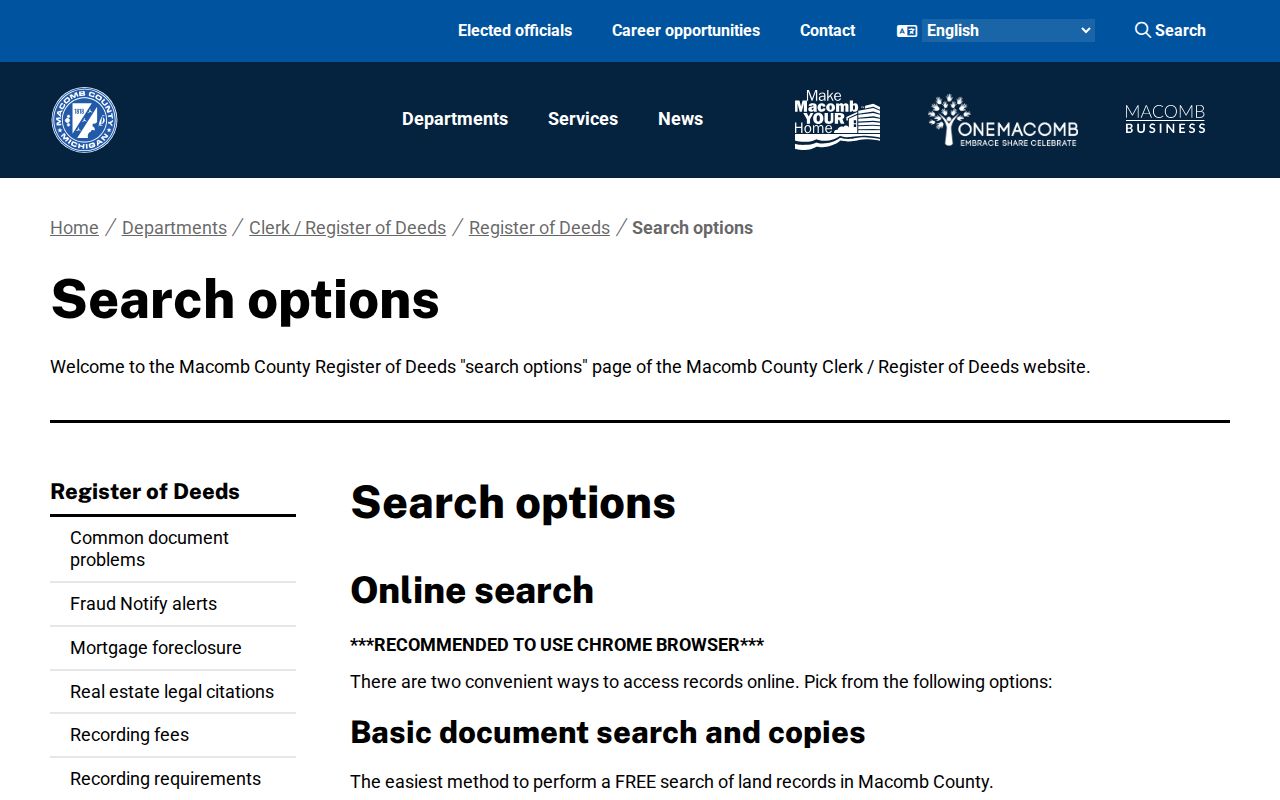
Use that choice of channels to preserve the same parcel and legal-description trail when the online result alone is not enough.
Trace Roseville Previous Residents Through Deeds
A deed chain tracks title, so it is the best way to move backward through owners of record. Start with the present parcel information, rather than assuming a street label stayed constant. The Roseville house-history guide directs researchers to begin with a complete address, legal description, or lot number and then follow the grantor and grantee indexes. Mortgage, discharge, and assignment records can add dates and party names, but they do not replace the transfer deed.
- Use the Roseville assessor or BS&A record to capture the current parcel ID and legal description.
- Find the latest recorded deed and note its date, instrument information, buyer, seller, and legal description.
- Search the seller as a prior grantee, while matching the same legal description.
- Repeat that backward handoff and record every uncertain match, indexing warning, and address change.
- If the index does not resolve the record, use the Mount Clemens terminal, a staff search, or the county mail-request procedure.
- Grantor
- The party transferring an interest in the recorded instrument.
- Grantee
- The party receiving that interest, whose earlier purchase may lead to the next deed.
- Chain of title
- The sequence of recorded transfers connecting one owner of record to an earlier one.
- Legal description
- The lot, block, subdivision, or other formal parcel description used to hold the trail together when a street address changes.
Roseville Addresses Need Old Names
Previous residents can disappear from a search when the same place was filed under a different road or jurisdiction label. Roseville’s record geography runs through Orange Township, Erin Township, the village era, and the city incorporated in 1958. A historic entry may instead use an East Detroit-area label or a county description. Keep the original wording in the notes and add the modern Roseville reference beside it.
Road names supply a second crosswalk. Gratiot was Erin Plank Road, 11 Mile was Townhall Road, 12 Mile was Champagne Road, and 13 Mile was Cushy Road. Frazho also appears as Roseville Road and Bloss Road. Search both forms when an old deed, newspaper, or directory seems unrelated to the present address. Note: A historical address match should be supported by its parcel, lot, map, or surrounding landmarks before it is treated as the same property.
Roseville Previous Residents in Directories
Owners are only one part of who lived here before. Roseville’s 1955 and 1957 directories, and the nearby 1942-1958 East Detroit/Roseville/Fraser runs, can link a printed name to an address at an edition date. The Library of Michigan also advises searching neighboring and historical place labels, particularly because East Detroit became Eastpointe in 1992. A printed entry remains a snapshot. It does not establish title, uninterrupted presence, or every member of a household.
The Roseville library keeps city cross-indexes and yearbooks available by request, although archive research can be delayed while collections are reorganized. Its guide recommends directory evidence alongside deeds, newspapers, census schedules, plat maps, architectural surveys, and local recollection. The collections and their access paths receive fuller treatment in the Roseville directory book.
- Choose the nearest confirmed directory edition and copy the printed address exactly.
- Check the preceding and following available editions, while preserving any jurisdiction label.
- Pair the 1955 or 1957 address clue with the 1950 census release, then await later releases rather than assuming later census access.
- Compare the household clue with permits, the deed sequence, the Roseville Record, and an obituary or probate lead.
Roseville Permits and Map Clues
Permit records can explain when a structure was built or altered. Roseville Building materials identify a project location, work description, dimensions, estimated cost, permit number, issue date, and applicant or owner fields, subject to the city’s access rules. A permit dates an event at the property. It does not by itself prove that the named applicant was an occupant. For an older structure, compare the permit with the legal description, plats, atlases, and the deed sequence.
Macomb map evidence includes the 1875 D.J. Stewart atlas, the 1916 Ogle atlas, and the 1956 Rockford Farm Plat Book. Sanborn material can add building-footprint context, but a Roseville-specific sheet was not confirmed in the source review. Check the Library of Michigan or Library of Congress catalog before treating a particular Sanborn year as available for a Roseville address.
Roseville Previous Residents at Trail Endpoints
When a directory name stops appearing, the next useful question is whether a dated death notice, estate file, or public transfer explains the change. Mount Clemens Public Library’s Macomb County Obituary Index, the Roseville Record, South Macomb News, and selected Macomb Daily microfilm are leads for that work. Match a full name with a date, relationship clue, and address before connecting it to the parcel.
Macomb Probate Court’s party-name index may identify a case number and judge for an estate, guardianship, or related proceeding. A probate party is not automatically a former occupant or owner. The court and obituary lead should be compared with the address, deed, and family details before it is used in a Roseville previous-residents chronology.
Roseville Previous Residents at the Library
Roseville Public Library is the local referral point for city cross-indexes, yearbooks, Erin Township Records, the house-history guide, and the Montage digital collection. Montage offers more than 10,000 historic images, newspapers, documents, and oral histories that can be searched remotely by surname, street, institution, or event. It is a strong first check for a Roseville previous-residents question that reaches beyond the land records, especially when an older street, school, church, or civic group appears in the evidence.
Access conditions are important here. The library completed a major renovation, but archives material remains partly unpacked and research or reference help can be limited or delayed. Yearbooks and city cross-indexes are available by request at the information desk. Other archive material may require an archivist request. Roseville microfilm is in storage, and the library directs researchers to Mount Clemens Public Library Archives for access copies and procedures. Record the repository and access date with every item, since a collection’s shelf location is not the same as a claim about a former household.
Roseville Previous Residents Research Limits
Land records, maps, libraries, and courts preserve different parts of the past. A tax mailing address can differ from a situs address, a deed may establish title without showing a household, and an address-point result can be later than the historical event being studied. The most reliable result names the custodian, date, record identifier, and limitation beside each finding. When a record is restricted, unindexed, sealed, or not confirmed, leave that point unresolved and ask the custodian for the appropriate access route. Roseville research notes should retain contradictory evidence rather than force a neat household story.
House-history use. Keep Roseville previous-residents research focused on family history, an estate question, a property’s past, or civic history. Respect protected addresses, private household information, and the limits stated by each custodian.